Scottish clans and family roots
Tartan finder by surname: clan tartan, crest and motto
What tartan, crest, badge and motto actually mean, how to find your tartan by surname or clan and which claims need a second source.
What is a clan tartan
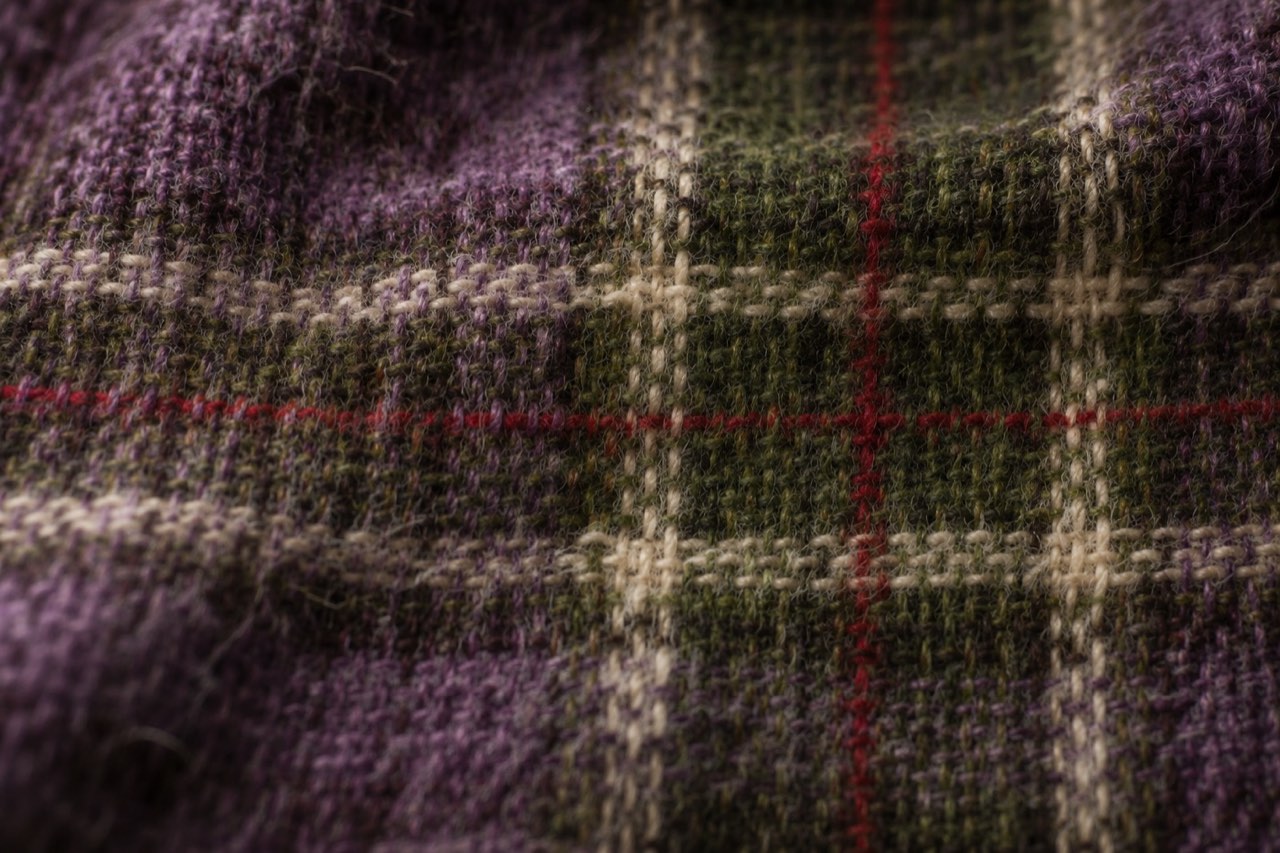
A tartan is a woven pattern of coloured stripes that repeat in a set order, and a clan tartan is a pattern associated with a clan or one of its branches. The pattern of a particular tartan is called its sett.
The Scottish Register of Tartans describes tartan as a pattern with two or more solid-coloured stripes repeated in a defined sequence. A sett is built from bands of set widths that cross at right angles, and where they cross the colours blend into new ones. That crossing of warp and weft threads is what makes a tartan different from a plain check.
The oldest tartan fragment found in Scotland is the Falkirk tartan, dated to the third century AD. It was found near the Antonine Wall, stuffed into an earthenware pot holding almost 2,000 Roman coins, and is now held by the National Museum of Scotland. It is a simple check in undyed light and dark wool. It shows that woven checks are old, but it does not show that clans had tartans in that period.
Clan vs district tartan
A district tartan belongs to a place, such as the Isle of Skye district tartan of 1992, and has no family association. A clan tartan belongs to a family. The formal system of clan tartans is often placed in the nineteenth century. In August 1822 George IV visited Edinburgh, the first visit to Scotland by a reigning monarch in almost two centuries, and the event, stage-managed by Sir Walter Scott, promoted tartan dress and Highland themes. Historians still discuss how much of the later system of clan tartans dates from that period, so a claim that a given pattern is ancient deserves a source.
Crest, badge and motto
The crest belongs to the chief, and clan members wear it in a badge. The motto is a short phrase in the badge, and a plant badge is a separate sprig of a plant linked to the clan.
Chief's crest
Heraldry in Scotland belongs to individuals. The Court of the Lord Lyon says that chiefs have the right to wear their crest as a badge, usually inside a plain circlet with the motto. Clansmen and clanswomen wear the chief's crest inside a strap and buckle, which the Court calls the sign of the clansman. Strictly speaking, then, there is no "clan crest", only the chief's crest, which members wear to show allegiance. Only people with their own registered arms, known as armigers, have a personal crest. Crests are not tied to surnames, so a "family crest" printed for a surname by a gift shop is not a record of arms.
Mottos and slogans
A motto is a short phrase. Examples include "Hold fast" (Clan MacLeod), "Per mare per terras", meaning "by sea and by land" (Clan Donald), and "Ne obliviscaris", meaning "do not forget" (Clan Campbell). A slogan is a heraldic motto or secondary motto that began as a war cry in many cases, and many slogans are in Scottish Gaelic. The Campbell slogan "Cruachan" is an example. Other languages used include English, Latin and Irish.
Plant badge
A plant badge is a sprig of a particular plant, usually worn in the bonnet behind the crest badge. Clans with historical or territorial links can share one. Juniper, for instance, is attributed to the Gunn, MacLeod, Murray, Nicolson of Skye and Ross clans.
How to find your tartan
A tartan finder by surname works in two steps: identify your clan first, then search the Scottish Register of Tartans and the clan society's own pages. A search by surname alone is less reliable.
By clan
Once you know the clan, search for it in the Scottish Register of Tartans, which is free to use and run by the National Records of Scotland. Many clans have more than one registered tartan, so check the colour variants, and the clan society can tell you which the chief prefers for formal occasions.
By surname
To find a tartan using a surname, start with the surname lists on the find your clan page, then search the Register under each clan that includes the name. A tartan name that matches a surname is not proof of descent. If a surname has no tartan, you may wear a district tartan, a national tartan or a pattern registered for an organisation.
How can I find my Scottish clan tartan?
Search for your clan in the Scottish Register of Tartans, check the colour variants and then ask the clan society which version it recommends. Compare the pattern with the clan society's own illustration, because background notes in the Register come from several sources and may contain inaccuracies.
How can I find my tartan using my surname?
Use the surname to find the clan or clans it is linked with, and then follow the steps above. The chain of surname, clan and tartan has three links, and each is a place where a mistake can enter.
How do I find my Scottish family crest?
You will find a chief's crest through the clan, but a personal family crest exists only if an ancestor registered arms in the Lyon Register. The Court of the Lord Lyon is the authority for these questions.
Are tartans still restricted
No. Tartans are no longer illegal in Scotland. The Dress Act of 1746 restricted Highland dress, including tartan for men and boys, and it was repealed in 1782.
The ban followed the Jacobite rising of 1745 and lasted for about two generations. Today anyone may wear any tartan. The Scottish Register of Tartans was created by an Act of the Scottish Parliament in 2008, which received royal assent on 13 November 2008, and the register opened on 5 February 2009. It records tartans so that their details are preserved, and registration is not a licence to wear them.
Using symbols correctly
Wear the clan tartan freely if you feel an association with the clan, but wear the crest badge in the way the Lord Lyon describes, as a member showing allegiance to the chief.
- Members wear the chief's crest within a strap and buckle. A circlet with feathers is for chiefs and armigers.
- In principle the crest badge should be used only with the chief's permission.
- Do not describe a modern pattern as ancient unless a source supports it.
- Avoid products that sell a "family crest" for a surname. They are not records of arms.
Sources and further reading
- The Scottish Register of Tartans, run by the National Records of Scotland.
- Court of the Lord Lyon, crests.
- Scottish Register of Tartans Act 2008.