Scottish clans and family roots
Highland Clearances and family history
What the Highland Clearances were, who made the decisions, where families went and how to research a cleared or emigrated family.
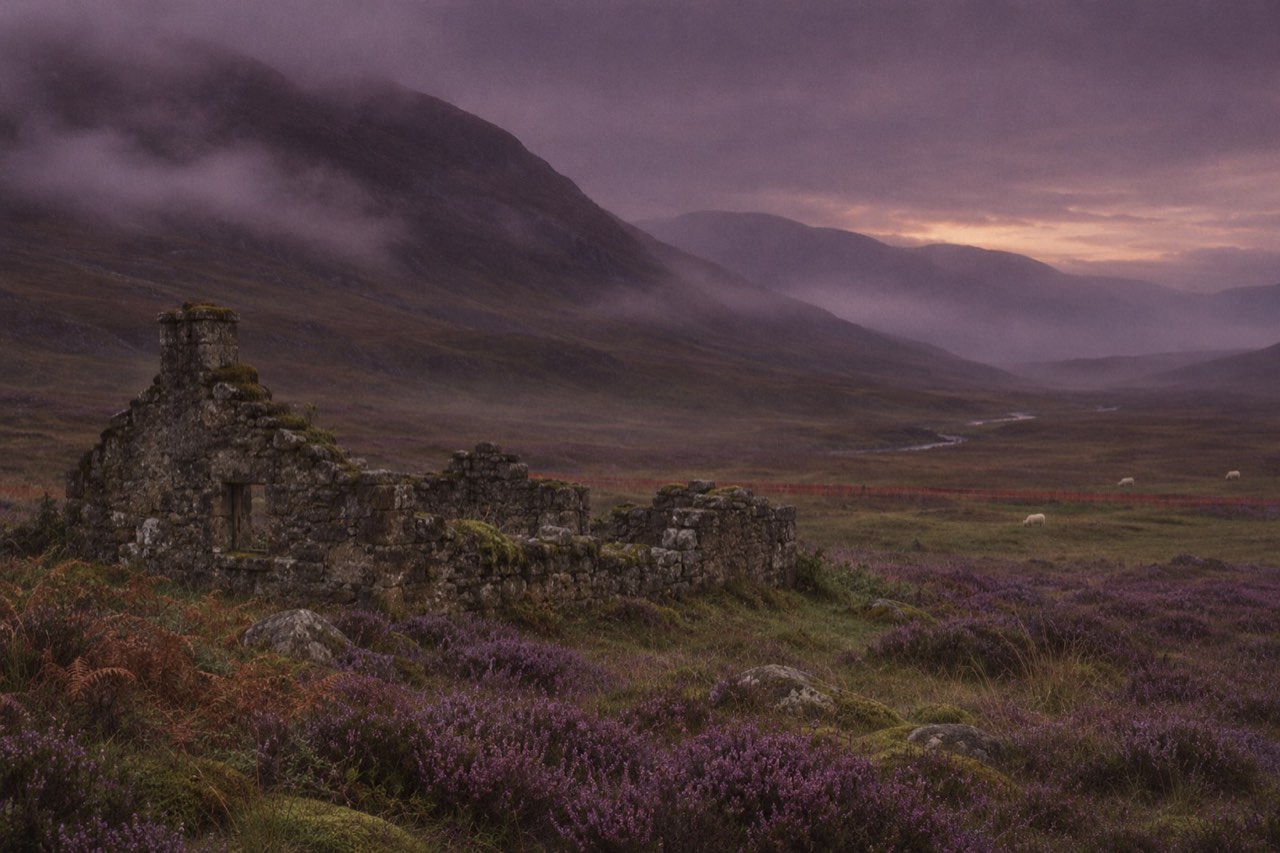
What were the Highland Clearances
The Highland Clearances were the removal of tenant families from Highland and Island land, mostly between about 1750 and 1860, so that estates could be used more profitably, chiefly for sheep.
Definition
The Gaelic name for the events is Fuadaichean nan Gàidheal, meaning the "eviction of the Gaels". In practice the Clearances were not one event, but a long run of local decisions by landowners and their factors. Some people were moved to new holdings on the coast or on poorer land, and others were removed altogether and left the Highlands. Many families had no written lease and little protection.
Period
Historians usually describe two phases. The first, from roughly 1760 to 1815, was mainly relocation within estates. The second, from about 1815 into the 1850s, involved expulsion, and the process reached a climax in the Highland Potato Famine of 1846 to 1855. The Crofters' Holdings (Scotland) Act of 1886 gave crofters security of tenure and is generally seen as the end of the Clearances, although it did not extend to cottars, who held no land of their own.
Causes and responsibility
The Clearances had several causes, and responsibility lay mainly with landowners and the factors who managed their estates, in a setting of falling income, famine and a changed relationship between chiefs and clan.
Large sheep farms paid higher rents than small tenancies, and the Cheviot sheep was the most productive breed. The kelp trade, which had given many coastal families seasonal work, fell after the Napoleonic Wars and had collapsed totally by 1820, leaving an estimated 25,000 to 40,000 crofters without that income. Blight reached Scotland in 1846 and affected Highland potato crops until about 1856. Landlord debt, overpopulation and prejudice against Gaelic speakers are also listed among the contributing causes.
The Sutherland estate is the best documented example. It was held by Elizabeth, Countess of Sutherland, and her factor Patrick Sellar was a key figure. The Strathnaver clearances began in 1814, when about 430 families, an estimated 2,000 people, were removed from Strathnaver and Brora. Sellar was charged over the burning of a house at Badinloskin on 13 June 1814, in which an elderly woman later died, and he was acquitted in 1816. James Loch oversaw clearances from 1818 to 1820, and 1819 was called the year of the burnings. Other landowners named in the record include Walter Frederick Campbell on Islay and Alexander Ranaldson MacDonell of Glengarry.
Who was responsible for the Highland Clearances?
The decisions were taken by landowners and their agents. Many of those landowners were descended from clan chiefs, and after 1746 the chief's role had moved from leader of a kin group to owner of an estate. Economic pressure and the absence of legal protection for tenants shaped what they did. A fair account names the owners and factors who gave the orders and also records the pressures they faced and the resistance of tenants.
How many died in the Highland Clearances?
There is no reliable total. The historian Eric Richards notes that no death has been directly attributed to the physical act of clearance itself, other than the elderly woman who died after the Badinloskin fire in 1814. That does not mean there was no suffering. Hardship on poor land, hunger in the famine years and the hazards of emigration are real, but they are hard to count and should not be given invented numbers.
Where families went
Cleared families often moved to the coast, to Lowland towns or overseas, above all to Canada, the Carolinas and Australia.
Some were resettled in crofting townships on the coast. Others went to Lowland towns and cities. The emigrant destinations named in the record include Nova Scotia, Prince Edward Island, New Brunswick, the Glengarry and Kingston areas of Ontario and the Carolinas. The Highland and Island Emigration Society helped families to Australia: around 11,000 people received assisted passages between 1846 and 1856, and about 5,000 more emigrated to Australia. Canadian Gaelic was spoken widely for about two centuries, and an estimated 100,000 Gaelic speakers lived in Cape Breton in the early twentieth century. If you are not sure whether your ancestors were cleared or simply moved, read the clan history timeline for the wider background, since the Clearances ended the old clan order.
Researching a cleared family
To research a cleared family, start with the census and old parish registers to locate the home parish, then add estate papers and emigration records.
Test the family story first
Many families hold a story that their ancestors were cleared. Check it against the dates. The 1841 census listed 167,283 people in the crofting region of the Highlands and Islands, so a great many households can be found in the record before the worst years. Ask whether the family appears in a parish in one census and in a different place, or a different country, in the next. A move of a few miles within the same parish is not emigration, and a departure after the 1860s is probably not a clearance. A story that fits the dates and the place is worth following with the estate papers below.
Estate papers
Landowners kept rentals, tenant lists and letters, and some of these survive in archives. They can name tenants by township and show when a township was cleared. Look for the estate in the National Records of Scotland catalogue and in local archives, and compare the dates with the last appearance of your family in the parish records. The 1841 census shows families before many clearances, and later censuses show who stayed.
Emigration records
There are very few records in the National Records of Scotland that list the names of emigrants, and the Highland and Island Emigration Society records are the main exception. Official outward passenger lists in the United Kingdom start in 1890 and are held by The National Archives in London, which leaves a gap for the main clearance period. For that gap, look for the arrival records in the destination country, church registers, land grants and obituaries. The University of Aberdeen's Scottish Emigration Database covers some later departures from 1890.
The records in the destination country often name the home parish, so a Canadian death certificate may give you the Scottish parish you need. Use that name to go back to the registers described in how to trace Scottish ancestors, and to clan and surname lists to test any family story about a clan.